 台灣出發了
台灣出發了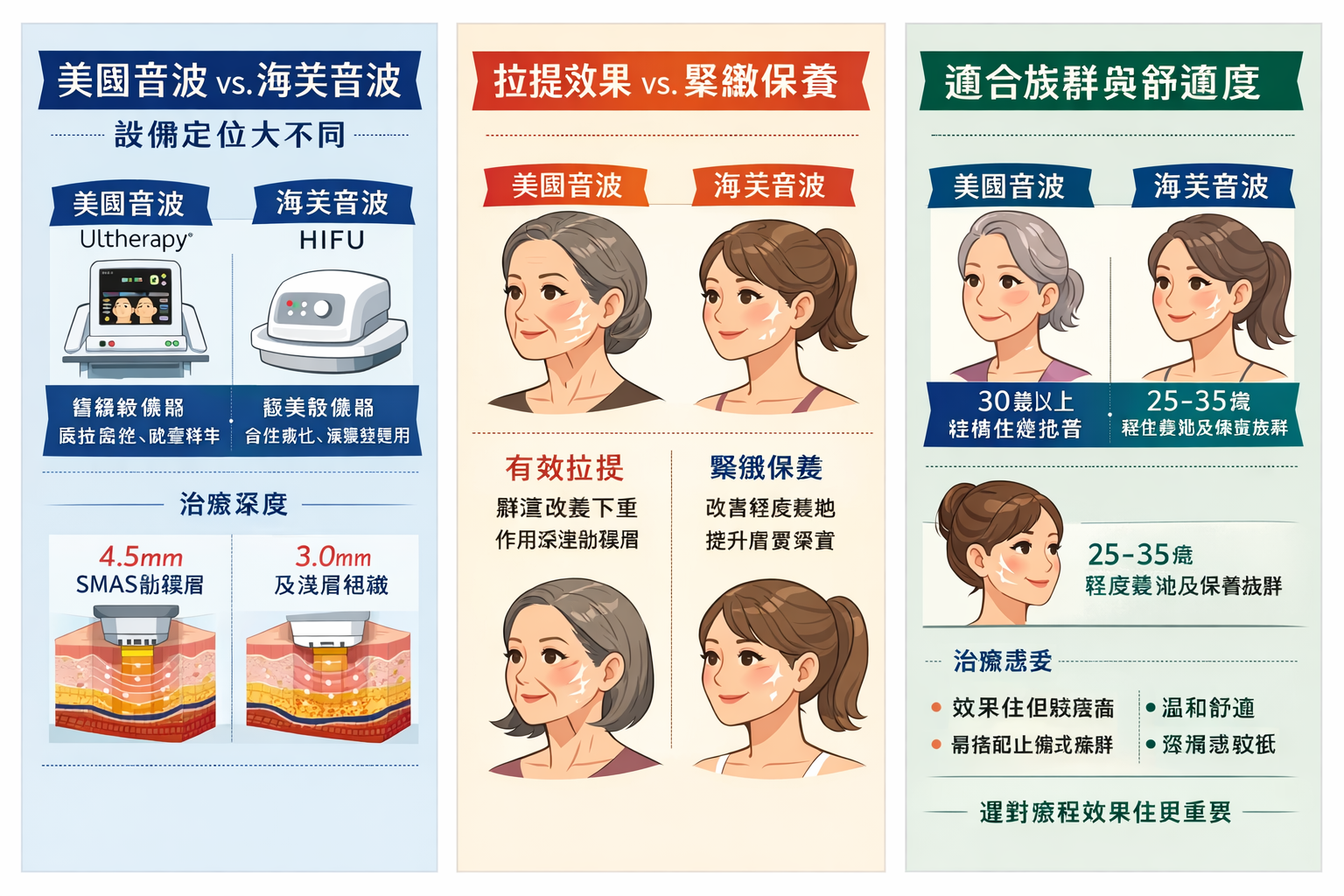
In non-surgical lifting treatments, ultrasonic lifting has long been considered a mainstream anti-aging option. However, during consultations, many people find significant differences in price and treatment claims between American ultrasonic and HIFU technologies. Although their names are similar and both rely on HIFU principles, their clinical effects and target audiences differ, so it is important to clarify these distinctions.
1. The treatment principles are the same, but the equipment used differs.
Both American ultrasonic and HIFU technologies use high-intensity focused ultrasound to concentrate energy at a specific depth beneath the skin, creating thermal coagulation points that stimulate collagen production and tissue contraction, thereby achieving lifting
and tightening effects. The difference lies in the type of equipment used. American ultrasonic, represented by Ultherapy, is a medical-grade device with strict energy output and safety monitoring standards, while HIFU devices are often classified as cosmetic-grade, focusing on cost-effectiveness and maintenance-oriented applications.
2. There are differences in energy stability and focal depth.
American ultrasonic delivers stable energy with precise focus, allowing it to effectively target the SMAS fascia layer at a depth of 4.5 mm, which significantly improves structural sagging. HIFU, on the o
ther hand, has relatively milder energy, with limited precision and penetration depth, so it primarily affects superficial and intermediate layers of tissue, resulting in less impact on the fascia.
3. The actual effects and duration of results vary.
The main advantage of American ultrasonic is its “lifting power.” It provides noticeable improvements for structural aging issues such as sagging contours, lip folds, and nasolabial folds, with effects lasting typically over a year
. HIFU, however, focuses more on providing a “tighter feel” and can offer visual improvements for mild sagging or early signs of aging, though the effects tend to be shorter-lived.
4>There are also differences in comfort and treatment experience.
Due to the higher energy per point, American ultrasonic can cause more noticeable discomfort during treatment, so pain relief or anesthesia is often used. HIFU, with
its lower energy, results in a milder treatment experience, less pain, and a faster recovery period, making it more tolerable for most patients.
5>Finally, the suitable candidate groups for these treatments also differ.
U.S. ultrasound is more suitable for people over 30 years old who have moderate structural laxity and wish to improve their contours and achieve noticeable results from lifting treatments. H
afei ultrasound, on the other hand, is better suited for individuals aged 25 to 35 with mild laxity or as part of a regular anti-aging routine.
U.S. ultrasound and Hafei ultrasound are not competing options in terms of quality; rather, they are designed for different age groups and specific needs. When choosing an ultrasound lifting treatment, it is important to consider one’s age, degree of laxity, and desired results. The decision should be made after a professional evaluation, rather than relying solely on price or the number of sessions. Only the right treatment will ensure ideal and safe anti-aging results.